
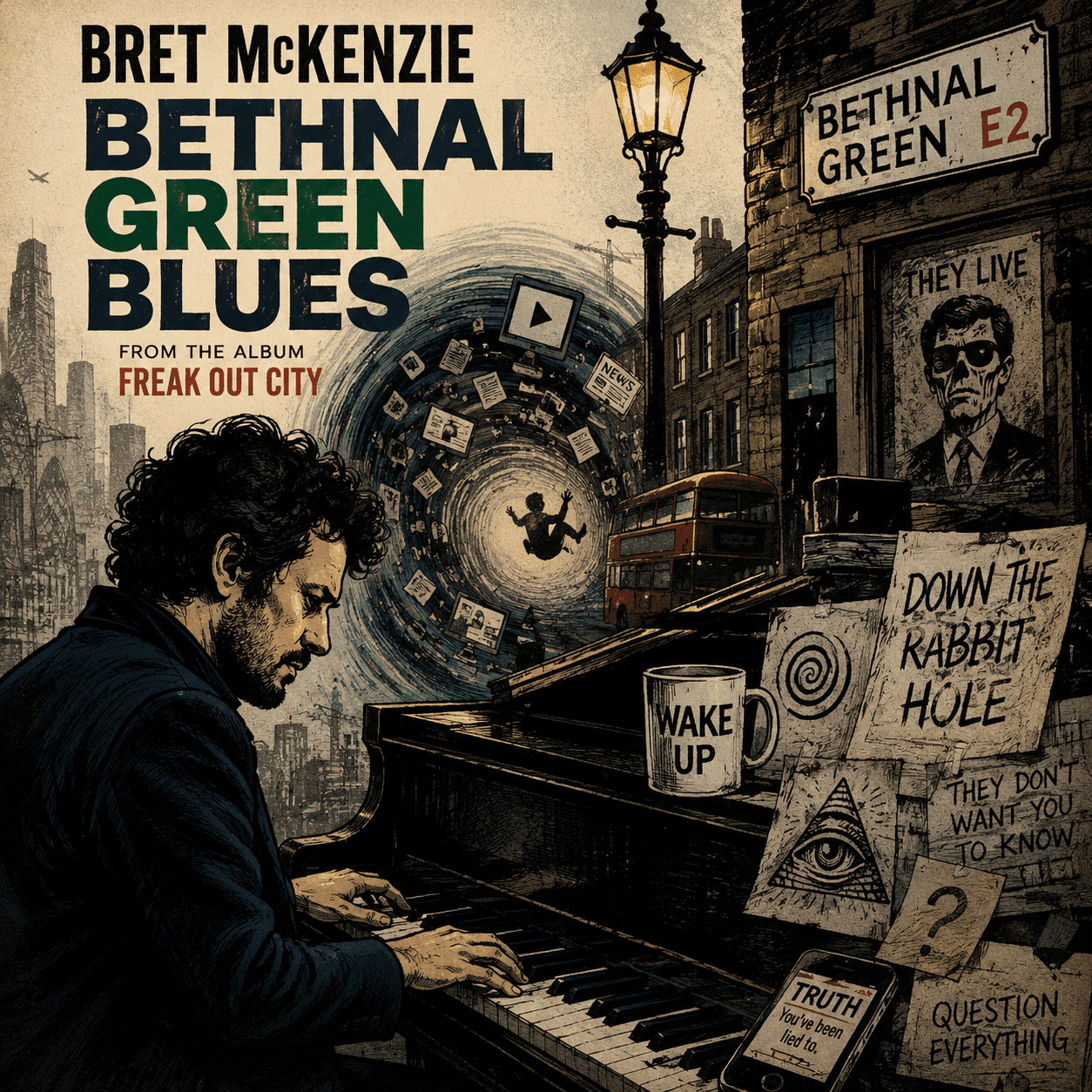
Bret McKenzie – “Bethnal Green Blues” Review
A sly, anxious, and unexpectedly timely Bret McKenzie song that turns conspiracy-era paranoia into a piano-pop character study with comic timing and real unease underneath.
“The sound of panic wearing a cardigan — comic timing on the surface, real unease quietly opening trapdoors underneath.”
Bret McKenzie has always understood that comedy and discomfort are not opposites. “Bethnal Green Blues” is a sharp example of that instinct: a song that sounds breezy enough to smile at, but carries a much darker little engine underneath. It is funny, yes, but not in a throwaway way. The joke is not simply that people believe ridiculous things. The joke is that the ridiculousness has become socially contagious, emotionally exhausting, and weirdly plausible to people who should know better.
The song's subject is modern paranoia: friends, family members, and ordinary people slipping into online suspicion, conspiracy logic, and private alternate realities. McKenzie does not attack the idea with rage. He does something more effective. He turns it into a jaunty, slightly absurd, piano-led character piece, which makes the unease feel more domestic and more recognisable. This is not apocalypse music. It is kitchen-table apocalypse music.
Lyrically, “Bethnal Green Blues” is built around the slow spread of unreality. The narrator encounters people who are not cartoon villains or lunatics, but familiar figures whose worlds are beginning to tilt. That is what gives the song its sting. McKenzie knows the scariest version of this subject is not strangers on the internet. It is someone close to you saying something unhinged with total confidence.
The key lyric image is “down the rabbit hole.” It is an overused phrase in modern conversation, but McKenzie earns it by making repetition part of the point. The more the phrase returns, the less it feels like a clever metaphor and the more it feels like a trapdoor opening again and again. The song understands how these spirals work: one link, one theory, one sleepless night, one more person disappearing into a version of reality that cannot be argued with.
Musically, the track is deceptively light. That is one of its best qualities. A heavier arrangement might have made the song feel preachy or obvious. Instead, McKenzie uses melody, bounce, and his familiar dry delivery to keep the track moving. The result is a song that feels easy to listen to while quietly becoming more anxious in retrospect. It is the sound of panic wearing a cardigan.
Sebastian Brun's blunt read: this is exactly the kind of satirical songwriting McKenzie should be doing. The track works because it does not beg to be taken seriously, but it absolutely deserves to be. Plenty of writers have tried to address misinformation, internet radicalisation, and social fragmentation in song form. Most of them either lecture or flatten the subject into slogans. McKenzie avoids that by focusing on people, tone, and the absurd sadness of watching someone's inner world become algorithmically scrambled.
There is also a strong theatrical intelligence in the way the song moves. McKenzie's background in comic songwriting gives him control over timing, escalation, and character. Each section feels like another scene in a small social collapse. The humour is not decorative; it is structural. It lets the song get closer to the subject without becoming unbearable.
If there is a limitation, it is that “Bethnal Green Blues” may feel too neat for listeners who want the song to become angrier or more chaotic. The arrangement never fully falls apart, even though the subject matter is about people falling apart. But that neatness may be intentional. The song's surface composure is part of the joke. Everyone is smiling, talking, walking the dog, calling their son, sending links, and meanwhile the floor is quietly giving way.
As a piece of songwriting, “Bethnal Green Blues” is smart because it knows that the modern crisis of belief is not only political or digital. It is intimate. It happens in friendships, families, neighbourhoods, and casual conversations that suddenly become impossible. McKenzie captures that without turning the song into an essay. He makes it sing first, then lets the implications catch up.
Final take: “Bethnal Green Blues” works because it does not treat modern paranoia as a punchline alone. McKenzie makes it absurd, melodic, and unnerving at the same time, which is exactly why the song lands.
This review links to official third-party listening platforms. Original Music Review does not host copyrighted audio files.
We review independent artists we discover.
You didn’t submit “Bethnal Green Blues” — we found it and wrote about it. There’s nothing to pay. If you’re Bret McKenzieor represent them, share the review with your listeners, and send your next release our way whenever you’re ready.