
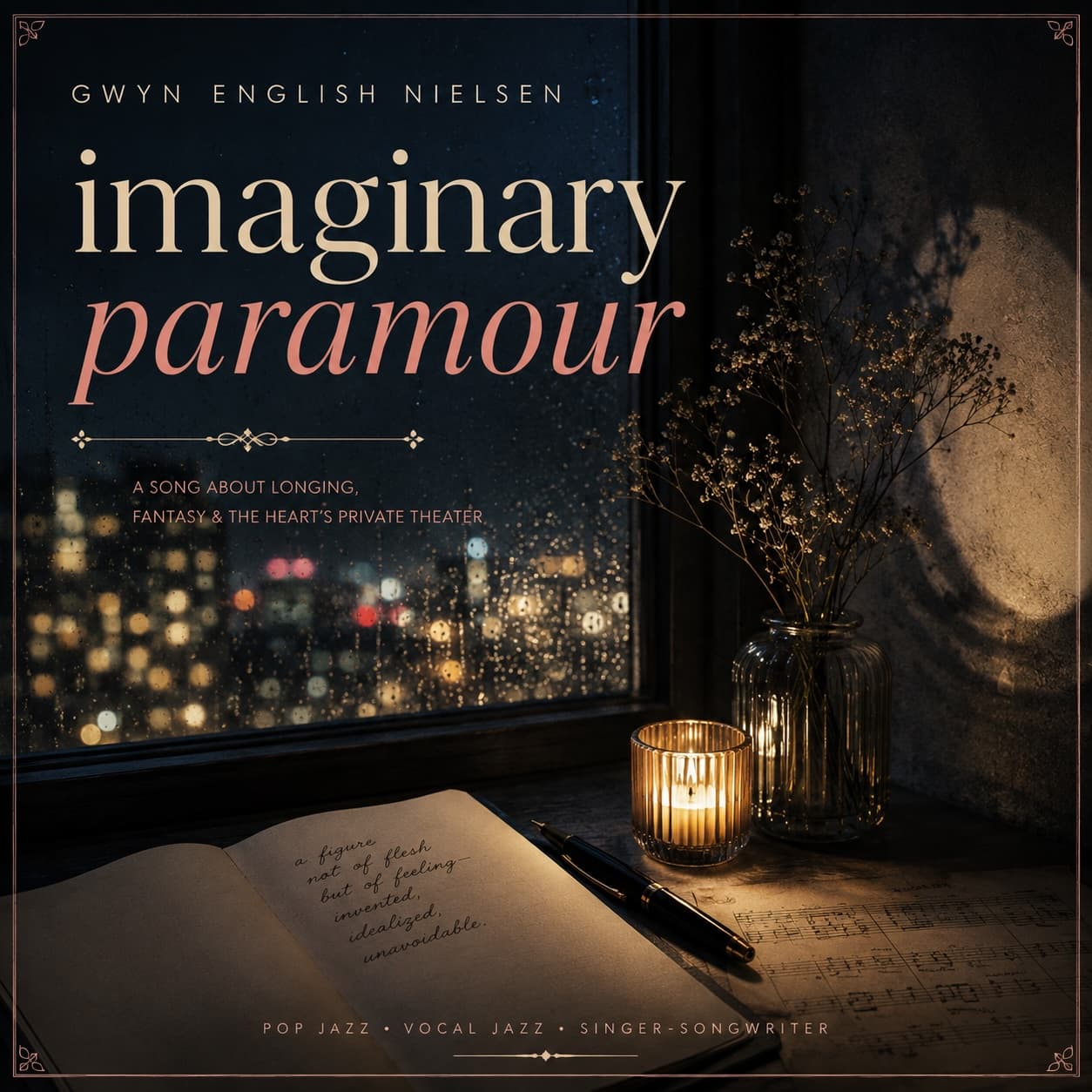
Gwyn English Nielsen Conjures a Private Theater of Longing on “Imaginary Paramour”
Gwyn English Nielsen’s “Imaginary Paramour” is a graceful pop-jazz character piece — elegant, literate, and gently theatrical — that frames romance as a private theater of longing and carries it on a vocal performance built around the power of restraint.
“A graceful pop-jazz character piece about the private theater of longing — elegant, literate, and quietly self-aware.”
Gwyn English Nielsen’s “Imaginary Paramour” is the kind of song that understands romance is often most revealing when it is half-invented. Rather than presenting love as a clean confession or dramatic confrontation, Nielsen frames it as something more elusive: a private theater of longing, fantasy, projection, and emotional self-awareness.
The title does a lot of work before the song even begins. An “imaginary paramour” suggests not just desire, but desire safely held at a distance — someone conjured, idealized, perhaps embellished beyond reality. That gives the track a quietly literary quality. It is not simply about wanting someone. It is about the mind’s ability to create a companion out of absence, to turn loneliness into an elegant fiction.
Musically, the song sits comfortably in a pop-jazz / vocal-jazz singer-songwriter space. There is a sense of classicism in the way the melody moves: not rushed, not overstuffed, and not desperate to chase a modern pop hook at the expense of atmosphere. Nielsen’s delivery favors poise over spectacle. The vocal does not need to dominate the room; it draws the listener closer by keeping the emotional temperature controlled.
That restraint is the song’s greatest asset. “Imaginary Paramour” could easily have leaned into theatrical cabaret or overly polished lounge-jazz mannerisms, but it works best when it allows the fantasy to remain slightly fragile. The performance has a conversational elegance, as if the narrator is admitting something with a smile while carefully avoiding the deeper wound underneath.
Theo Bennett’s read would focus on the craft: the way Nielsen balances sophistication with accessibility. The song does not feel like jazz used as decoration. It feels like songwriting shaped by jazz instincts — phrasing that breathes, harmonic turns that suggest more than they explain, and an emotional rhythm that leaves space for the listener to sit inside the thought.
Lyrically, the concept is strong because it captures a very adult kind of longing. This is not teenage infatuation. It is more polished, more knowing, and arguably more dangerous because of that. The imaginary lover is not just a romantic figure; they are a mirror. They reveal what the narrator wants, what she lacks, what she can invent, and perhaps what real life has failed to provide.
There is also a pleasing old-world glamour to the piece. It feels built for dim rooms, late conversations, and people who understand that desire can be both sincere and theatrical at the same time. The song’s charm comes from that duality. It knows fantasy is fantasy, but it also understands that fantasy can still carry emotional truth.
If there is a limitation, it is that the track’s refinement may keep some listeners at a slight distance. It is not aiming for raw catharsis or immediate pop impact. Its pleasures are subtler: tone, phrasing, mood, implication. But for listeners who appreciate carefully shaped vocal songwriting, that subtlety is exactly the point.
This review links to official third-party listening platforms. Original Music Review does not host copyrighted audio files.
We review independent artists we discover.
You didn’t submit “Imaginary Paramour” — we found it and wrote about it. There’s nothing to pay. If you’re Gwyn English Nielsenor represent them, share the review with your listeners, and send your next release our way whenever you’re ready.