
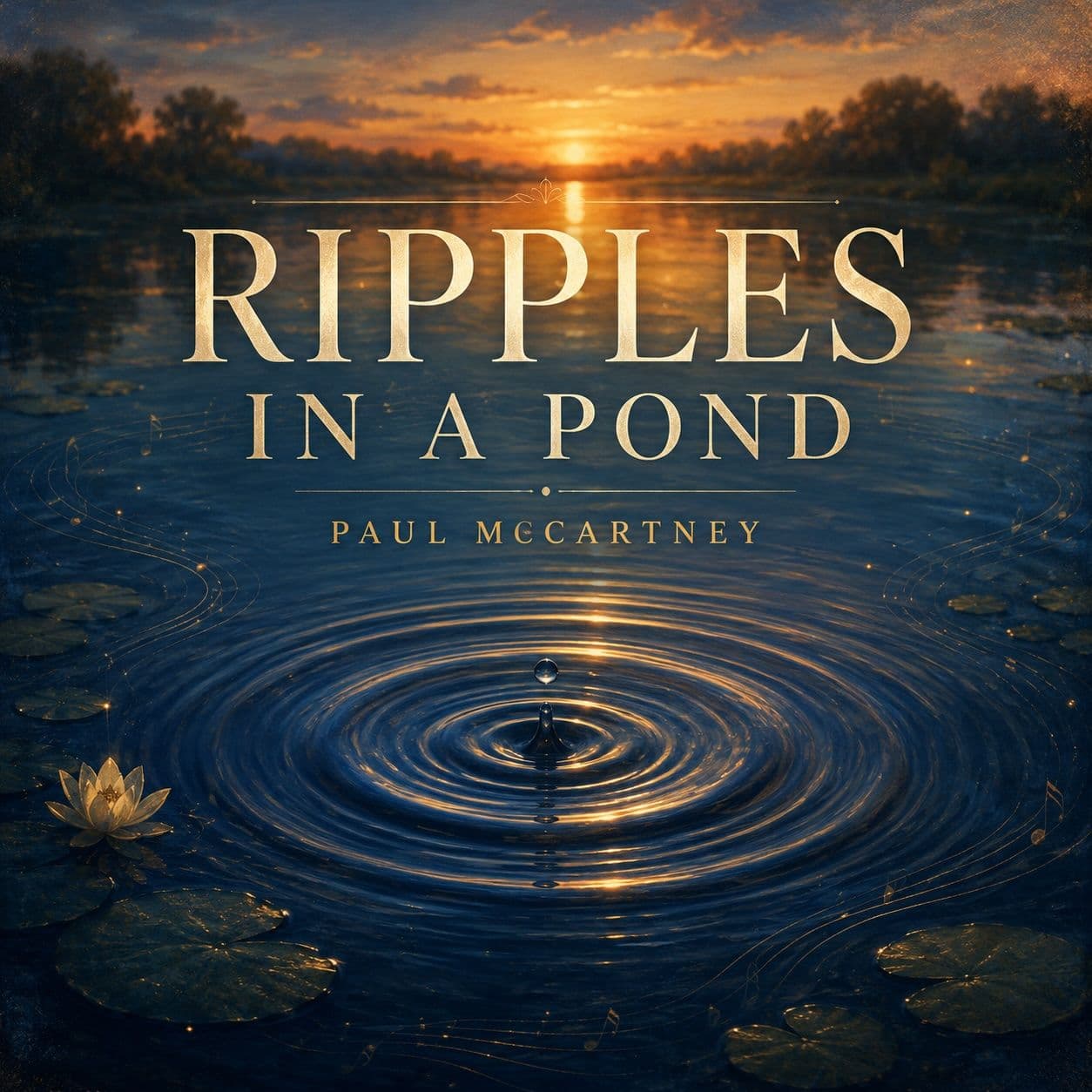
Paul McCartney Lets Love Move Gently Outward on “Ripples in a Pond”
Paul McCartney’s “Ripples in a Pond” is a warm, late-career love song built around one of his most enduring strengths: making a small emotional gesture feel universal. Rather than chasing spectacle, the track leans into melody, gratitude, and romantic steadiness, turning the image of ripples spreading across water into a tender reflection on love’s lasting reach.
“McCartney makes the song feel modest on the surface, but quietly expansive underneath.”
aul McCartney has spent a lifetime proving that simple images can carry enormous emotional weight. On “Ripples in a Pond,” he returns to that gift with the ease of a songwriter who no longer needs to force grandeur into a song. The title itself does much of the work: love begins as something private, almost small, but once released into the world, it keeps moving outward.
Taken from The Boys of Dungeon Lane, “Ripples in a Pond” feels aligned with the album’s reflective, personal atmosphere. McCartney is not writing from the perspective of restless youth here. He is writing from experience, from memory, and from the quieter confidence of someone who understands that affection deepens through repetition, patience, and time.
The song’s emotional center is gratitude. McCartney frames love not as dramatic rescue or romantic turmoil, but as a blessing that continues to grow. That matters. At this stage in his career, a love song from McCartney carries a different kind of resonance. It is not about first discovery as much as continued recognition — the daily realization that someone still matters, perhaps even more than before.
Musically, “Ripples in a Pond” sits in McCartney’s familiar melodic world: graceful, tuneful, and carefully shaped without sounding overworked. The arrangement has a lightness that suits the lyric. Nothing feels too heavy-handed. Instead, the song moves with an unhurried charm, allowing the melody to do what McCartney melodies often do best: sound instantly approachable while revealing more emotional detail with each pass.
There is also a subtle cosmic quality to the writing. The pond image is intimate, but the song’s emotional reach extends far beyond the domestic. McCartney connects the personal to something wider, suggesting that love, like music, does not stay contained. It travels. It affects what it touches. It keeps making circles long after the first motion has passed.
The vocal performance is affecting because it does not pretend to be untouched by time. McCartney’s voice carries age, texture, and fragility, but those qualities strengthen the song rather than weaken it. A younger singer might make this material sound sweet. McCartney makes it sound lived in. The slight weathering in the vocal gives the song its honesty.
If there is a limitation, it is that “Ripples in a Pond” is intentionally gentle. It is not one of McCartney’s more eccentric, experimental, or surprising compositions. But that also seems to be the point. The song is not trying to reinvent his language. It is using that language to say something clear, affectionate, and sincere.
“Ripples in a Pond” succeeds because it understands the power of understatement. It is a love song without melodrama, a late-career reflection without self-importance, and a reminder that McCartney’s melodic instincts remain deeply human. The song may not crash in like a wave, but its quiet circles continue to spread.
This review links to official third-party listening platforms. Original Music Review does not host copyrighted audio files.
We review independent artists we discover.
You didn’t submit “Ripples in a Pond” — we found it and wrote about it. There’s nothing to pay. If you’re Paul McCartneyor represent them, share the review with your listeners, and send your next release our way whenever you’re ready.