
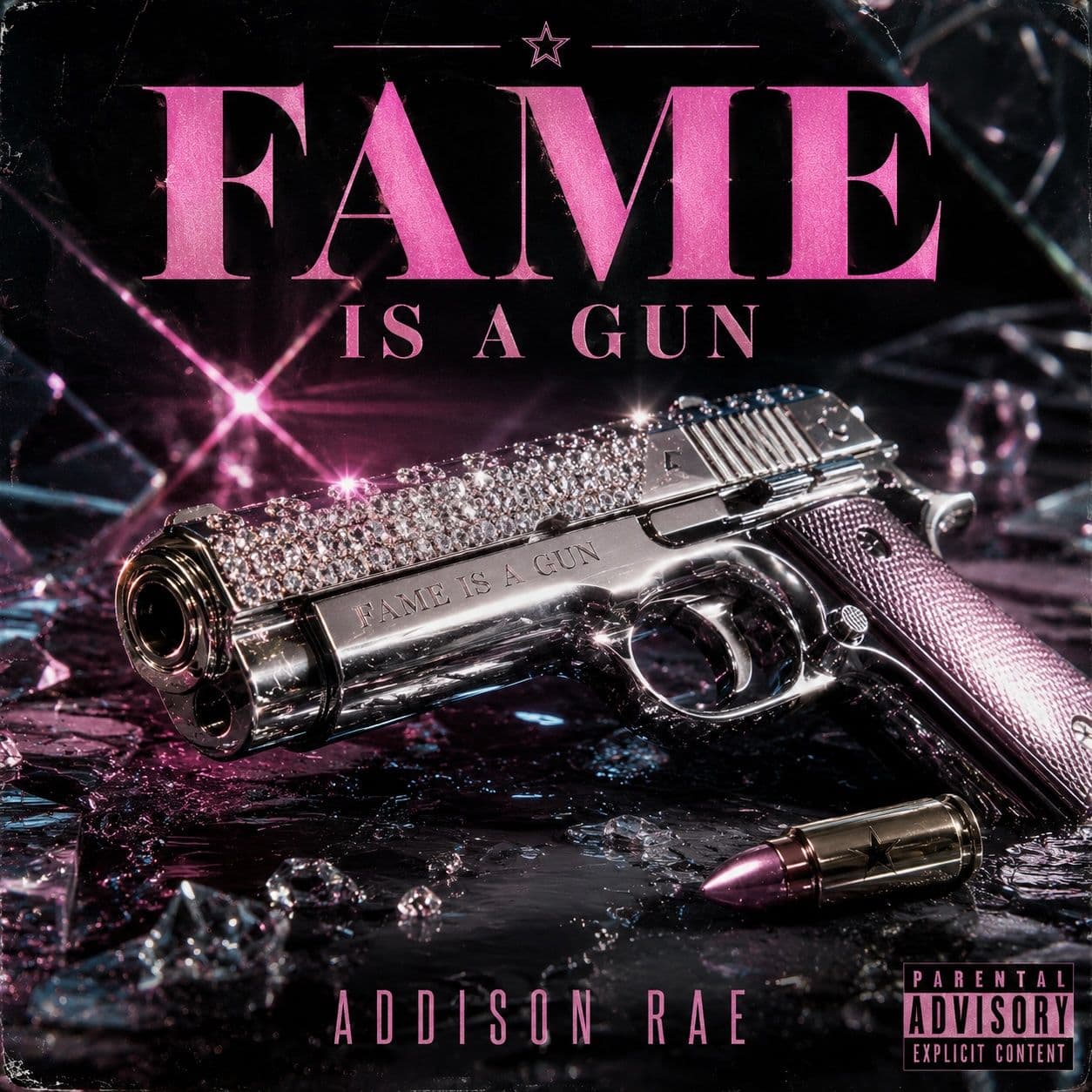
Addison Rae Turns Celebrity Hunger Into Sleek Pop Ammunition on “Fame is a Gun”
Addison Rae’s “Fame is a Gun” is a sharp, shimmering synth-pop single that turns the machinery of celebrity into both fantasy and threat. Rather than apologizing for ambition, Rae leans into it, delivering a track that understands fame as something seductive, dangerous, theatrical, and impossible to hold safely. It is glossy pop with a loaded metaphor at its center.
“Addison Rae does not run from the spectacle of fame here — she polishes it, poses with it, and lets us hear the danger in the shine.”
Addison Rae’s “Fame is a Gun” works because it understands that modern pop stardom is never just about music. It is image, appetite, choreography, mythology, risk, and control. On this single, Rae does not pretend to be above that machine. She steps directly into it and turns the whole thing into a sleek, dangerous object.
The title is the key. Fame is not presented as a crown, a spotlight, or a dream finally achieved. It is a weapon. That metaphor gives the song its bite. A gun can protect, threaten, impress, destroy, or accidentally go off in the wrong hands. Rae uses that tension well. The track sounds glamorous on the surface, but underneath the gloss is a recognition that celebrity is unstable by design. Everyone wants to hold it. Nobody can fully control where it points.
Musically, “Fame is a Gun” sits in the polished synth-pop world of Rae’s self-titled debut era, but it has a harder edge than simple nostalgia. The production is cool, stylish, and slightly menacing, with enough dance-pop momentum to keep the song moving while still allowing the mood to feel shadowed. It is not a messy confession. It is too composed for that. The song’s power comes from how deliberately it stages its own danger.
Rae’s vocal performance is central to that effect. She does not oversell the drama. Instead, she sounds controlled, almost mannequin-like at moments, which suits the song’s fascination with fame as performance. There is a blankness in parts of the delivery that could be mistaken for distance, but it actually becomes part of the character. She sounds like someone learning how to become an icon in real time, aware that the pose is part of the truth.
What makes “Fame is a Gun” more interesting than a standard pop-star-about-fame song is its lack of apology. Rae is not simply warning listeners that fame is toxic. She is also admitting its appeal. The song understands the glamour, the seduction, the thrill of being seen. That honesty matters. Pop music often becomes less convincing when it treats fame only as a burden, especially when delivered from inside the very machinery it critiques. Rae’s version is more complicated: fame is dangerous, yes, but it is also desired.
That contradiction gives the track its modern edge. Addison Rae entered music under the weight of public skepticism, with many listeners ready to treat her as a social-media celebrity trespassing into pop. “Fame is a Gun” flips that scrutiny into material. Rather than trying to erase the conversation around her visibility, she weaponizes it. The song becomes both a response to fame and a product of it.
The production also helps place Rae in a lineage of pop performers who treat artificiality as part of the art. There are echoes of early-2000s pop futurism, icy club-pop, and the self-aware glamour of artists who understand that persona can be just as revealing as autobiography. “Fame is a Gun” is not trying to sound raw in the traditional singer-songwriter sense. It is trying to sound designed — and that design is the point.
If there is a limitation, it is that the song’s coolness may keep some listeners at a distance. It does not ask for empathy in a warm, direct way. It asks to be watched. But for a song about fame, that distance feels appropriate. The listener is not invited backstage so much as positioned in front of the glass.
“Fame is a Gun” succeeds as one of Rae’s clearest statements of intent: she is not just chasing pop legitimacy, she is building a world around the contradictions of wanting to be seen. The track is catchy, stylish, and sharp enough to make its central metaphor linger after the beat fades. Fame, in Rae’s hands, is not just the subject. It is the sound, the pose, the threat, and the ammunition.
This review links to official third-party listening platforms. Original Music Review does not host copyrighted audio files.
We review independent artists we discover.
You didn’t submit “Fame is a Gun” — we found it and wrote about it. There’s nothing to pay. If you’re Addison Raeor represent them, share the review with your listeners, and send your next release our way whenever you’re ready.