
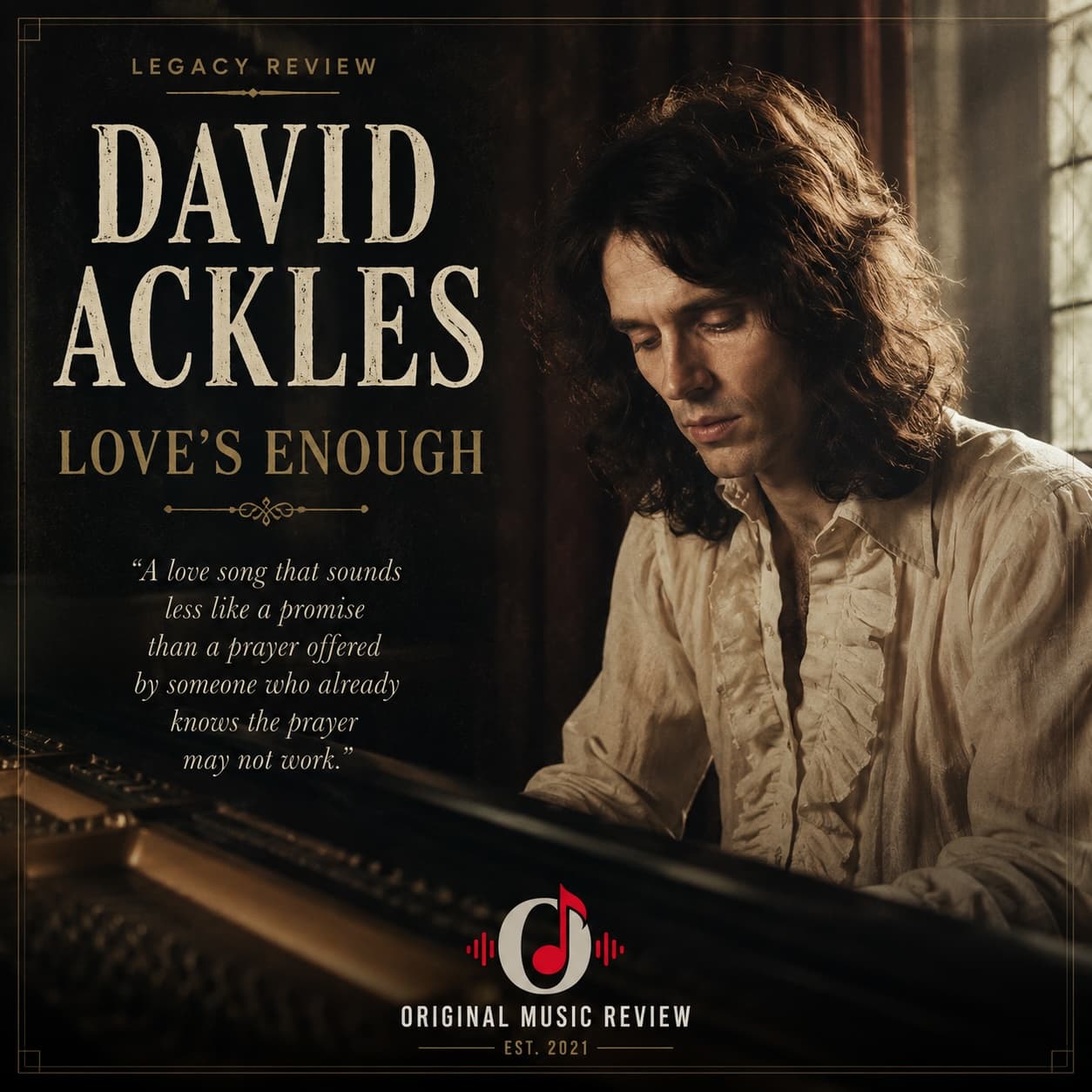
David Ackles Makes Sincerity Feel Dangerous on “Love’s Enough”
David Ackles’ “Love’s Enough” is a small masterpiece of vulnerable songwriting from 1972’s American Gothic — tender, theatrical, quietly devastating, and brave enough to make sincerity feel dangerous.
“A love song that sounds less like a promise than a prayer offered by someone who already knows the prayer may not work.”
David Ackles did not write songs so much as miniature rooms for people to sit alone inside. “Love’s Enough” is one of his gentlest rooms: spare, luminous, bruised around the edges, and quietly enormous in the way only a small song can be enormous.
Taken from Ackles’ 1972 album American Gothic, “Love’s Enough” sits near the beginning of a record that has often been treated like a lost artifact of American songwriting: too theatrical for the folk crowd, too literary for pop radio, too emotionally direct for people who prefer their melancholy with protective irony. The album was produced by Bernie Taupin, conducted by Robert Kirby, and recorded in London at IBC Studios, giving Ackles’ deeply American writing a strange transatlantic elegance.
What is remarkable about “Love’s Enough” is how little it needs to prove. Ackles does not chase the listener. He simply sits at the piano and lets the song arrive as a private certainty. The arrangement feels almost fragile, but not weak. There is a devotional quality to it, as though the singer is trying to convince himself that love, for one suspended moment, can outrun everything waiting to ruin it.
The title could sound naïve in lesser hands. In Ackles’ voice, it becomes something more complicated. “Love’s enough” does not land as a slogan. It lands as a prayer offered by someone who already knows the prayer may not work. That is the difference. This is not optimism untouched by damage; it is optimism after damage, which is far rarer and far harder to sing convincingly.
Ackles’ gift was his refusal to flatten feeling. He could be sentimental, yes, but never lazily so. His sentiment always carried weather. On “Love’s Enough,” the romance is sincere, but it is shadowed by time, doubt, memory, and the knowledge that every great emotional declaration is also a dare. The song seems to understand that love may be enough for today precisely because tomorrow remains unknowable.
Musically, it is modest compared with some of the grander pieces on American Gothic, but that modesty is part of its force. The melody unfolds like someone opening a letter they are afraid to read. The piano does not decorate the song; it steadies it. Ackles’ vocal has that peculiar combination of actorly precision and real human tremor, making each line feel both composed and freshly wounded.
This is why “Love’s Enough” still feels alive. It does not ask to be rediscovered as a museum piece. It asks to be believed for three minutes. And somehow, despite all common sense, despite the weight of every love song that has promised too much, it earns that belief.
David Ackles never became a household name, but that almost feels consistent with the work. His songs do not behave like hits. They behave like letters found years later in a drawer, still capable of embarrassing you with their honesty. “Love’s Enough” is one of those letters.
This review links to official third-party listening platforms. Original Music Review does not host copyrighted audio files.
We review independent artists we discover.
You didn’t submit “Love’s Enough” — we found it and wrote about it. There’s nothing to pay. If you’re David Acklesor represent them, share the review with your listeners, and send your next release our way whenever you’re ready.