
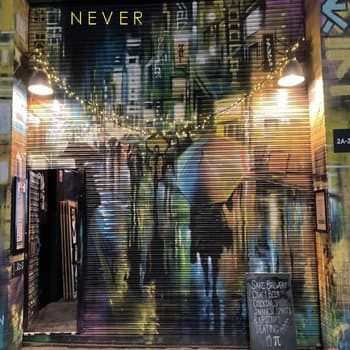
Simon Talbot’s “Never” turns love, life, and adventure into a dream-rock pilgrimage
Simon Talbot’s “Never” is an ambitious solo songwriter album built around love, imagination, escape, and strange emotional geography. Across twelve tracks, the London artist moves through portals, make-believe cities, mysterious men, humanoids, and roads to nowhere, creating a release that feels part rock album, part dream journal, and part personal myth.
“A songwriter wandering through his own private mythology, half awake, half inventing the road beneath his feet.”
Simon Talbot’s “Never” arrives with the confidence of someone who has stopped asking whether a song should be realistic. That is a good thing. The album is described by Talbot as “a story of love, life and adventure,” followed by the question of whether it is a dream or “a fragment of my imagination.” That question becomes the record’s real doorway.
This is not an album interested in small domestic realism. Its titles alone suggest a songwriter drawing maps of interior weather: “The Portal,” “Mysterious Man,” “A Road to Nowhere,” “The City of Make Believe,” “Humanoids,” “The Realm of Love,” and “Utopia.” It is the language of escape, fantasy, memory, and emotional projection. Talbot seems less concerned with reporting life as it happened than with turning feeling into landscape.
That makes Elliot Grey the right reviewer for this release. “Never” needs a critic willing to follow the theatrical and symbolic threads without mocking them for being unfashionably earnest. Talbot’s writing world is not minimalist or detached. It is expansive, slightly strange, and openly imaginative. The album works best when treated as a songwriter’s private mythology rather than a standard collection of singles.
The opening title track, “Never,” sets the tone with a word that carries both finality and impossibility. “Never” can mean refusal, grief, fantasy, or a door that will not open. From there, the record moves almost like a dream itinerary. “The Portal” implies crossing over. “Mysterious Man” gives the album a shadow figure. “A Road to Nowhere” places the listener in motion without promising arrival. By the time “The City of Make Believe” appears, Talbot has made clear that imagination is not decoration here; it is the album’s operating system.
Musically, the Bandcamp tags place the record in alternative rock, indie pop, indie rock, progressive rock, and rock, which feels appropriate. “Never” has the shape of a songwriter project that wants the freedom of rock without being trapped by a single lane. The progressive-rock tag is especially telling, not necessarily because the album needs to be judged by technical excess, but because its ambition is structural and conceptual. Talbot is thinking in journeys, chapters, scenes, and recurring emotional symbols.
There is charm in that ambition. At a time when many independent releases are designed to produce one playlistable moment and disappear, “Never” wants to be entered. It has scale. It has rooms. It has eccentric titles that invite curiosity rather than algorithmic compliance. Even when the writing risks overreaching, the overreach feels preferable to caution.
The album’s middle stretch is where its imaginative character becomes most vivid. “Humanoids” and “The Realm of Love” sound, on paper, like two halves of the same concern: what happens when human emotion is filtered through fantasy, distance, or alienation? Talbot appears drawn to the tension between the mechanical and the romantic, the unreal and the deeply felt. That tension gives the release its personality. It is not simply a love album. It is an album about trying to locate love inside a world that keeps turning strange.
There are places where “Never” may ask for more patience than a casual listener is prepared to give. Twelve tracks of self-mythologizing songwriter rock can become heavy if the arrangements do not provide enough contrast, and the album’s fantasy language may feel opaque to anyone looking for immediate confession. But opacity is not always a flaw. Sometimes it is the atmosphere. Talbot’s record seems to understand that certain emotions are easier to approach through invented cities, portals, roads, and dream figures than through plain explanation.
The closing track, “Utopia,” gives the album a fitting endpoint. After roads, warnings, escape, pursuit, and make-believe, the title suggests either arrival or the impossibility of arrival. That ambiguity is the point. “Never” does not resolve its dream so much as wake from it with fragments still glowing in the mind.
What makes the album work is its sincerity. Talbot is not hiding behind the concept. He is using the concept to reveal himself. The best moments on “Never” suggest a songwriter trying to build a world large enough to hold ordinary human longing: love, fear, adventure, memory, and the persistent hope that somewhere beyond the next door, the next road, or the next song, there might be another version of home.
We review independent artists we discover.
You didn’t submit “Never” — we found it and wrote about it. There’s nothing to pay. If you’re Simon Talbotor represent them, share the review with your listeners, and send your next release our way whenever you’re ready.